
Physical Deconditioning in Children
| October 2026ARTICLE SUMMARY
Physical deconditioning can affect a child’s strength, endurance, mobility, and participation. But early, consistent intervention can help interrupt the cycle of inactivity. In this second installment, readers will learn how care teams assess deconditioning and build movement into a child’s daily life.
- A physical deconditioning diagnosis is based on history, observation, and functional assessment—not one laboratory test.
- Baseline measures can help teams distinguish disease progression from secondary deconditioning.
- Physical therapy for deconditioning should be individualized to the child’s abilities and medical needs.
- Adaptive standers, gait trainers, activity chairs, and cycles can create meaningful movement opportunities.
- The most effective physical deconditioning treatment continues consistently at home and school.
Understanding the Risk of Physical Deconditioning in Children with Limited Mobility
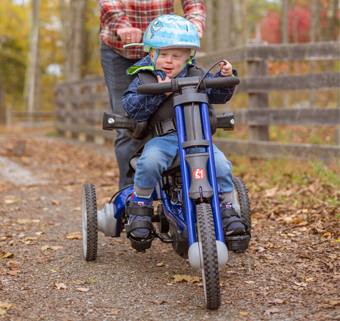 Identifying children at risk for physical deconditioning by assessing their physical condition early and regularly can help prevent long-term functional decline. For children with complex diagnoses, such as progressive neuromotor conditions, it is important to maintain a distinction between disease progression and secondary deconditioning.
A physical deconditioning diagnosis is primarily clinical. There is no single lab test that confirms it. Diagnosis relies on medical history and functional assessment.
Children in early childhood, school-age children, and those in young adulthood whose movement is limited in home and classroom settings are at highest risk. Identifying and assessing children with decreased physical activity levels and increased sedentary behavior will uncover the measurable consequences of physical deconditioning.
How Can Physical Deconditioning Be Assessed?
Effective diagnosis of physical deconditioning is achieved with interdisciplinary teams of PTs, OTs and physicians working together with parents, caregivers, and other related professionals.
Interview conversations with parents and school staff will provide a review of the child’s activity history, duration of immobility, and any changes in function.
Documenting Activity and Positioning Across 24 Hours
- Completing a 24-hour positioning chart over the course of a day or several days will provide insights into the child’s activity levels: 24 Hour Position Document
- Similarly, a 24-hour postural analysis “clock” provides a means of documenting day-to-day positioning and activity: 24 Hour Position Graph
These tools can reveal long periods of sedentary positioning as well as practical opportunities to add movement, active sitting, standing, or supported stepping to an existing routine.
Adapting Assessments for Non-Ambulatory Children
For non-ambulatory students who may possess minimal voluntary movement and require head/trunk supports, standard physical fitness tasks can be replaced by assessing physical activity levels instead.
For example, clinicians can teach school staff to monitor sustained heart rate during active adaptive positioning, mealtimes, or adaptive switch-use sessions to evaluate cardiovascular engagement.
Similarly, active flexibility tests are replaced with passive range of motion measurements for this population. In all cases, using the same assessments over time will document improvement or maintained status, or identify further deterioration.
Using Pediatric Physical Activity Questionnaires
Subjective or observational patient-reported outcome measures are available in the field of pediatric physical therapy. For example, a self-report activity scale, such as the PROMIS® Pediatric PA parent proxy short form 8a can guide therapists and parents in assessing a child’s sedentary vs. non-sedentary activity over a week’s time.
In using this scale for non-ambulatory children, a therapist can choose to prioritize the questions that yield the best clinical insights. For example, focus on Question 7 (activity lasting more than 10 minutes) and Question 6 (activity resulting in fatigue).
In the same vein, therapists may omit an inappropriate question such as Question 5 (muscles burning), since muscle soreness can easily be conflated with chronic structural pain. Therapists can also reword a question, modifying as needed—for example, Question 8 "How many days did your child run for 10 minutes?" is shifted to “How many days did your child take steps in a weight-supportive gait trainer?” Note that any modified uses of this scale, although useful, are not validated.
Measuring Activity and Cardiovascular Engagement
Objective measures can also be used. Accelerometry, and heart rate (HR) monitoring can be effective tools to assess physical activity and cardiovascular engagement. In their 2025 study, Toomer-Mensah and colleagues performed a one-week observational study with children with CP who were non-ambulatory.1
The physical activity of each study participant was examined using an accelerometry monitor (Actigraph GT9X) and a heart rate monitor (Fitbit Charge 4). These were placed on the child’s wrist to better capture upper extremity use in play, AAC switch activation, or self-propulsion in a wheelchair. Heart rate data was used in combination with direct clinical observation to verify whether a heart rate spike was in fact due to physical exertion versus other causes such as internal autonomic shifts or anxiety.
Interestingly, the researchers compared each childs physical activity amount and intensity to the child’s PROMIS® T-scaled score. PA intensity via activity counts derived from wrist worn monitors showed a strong positive correlation with the PROMIS® PA measure.
Functional Assessments
Functional assessments can be indicators of a child’s level of physical conditioning as well. For example:
Sit-to-Stand Function
- Five times sit-to-stand. Measure the length of time required for the child to perform.
- 30 second chair rise. Measure how many times the individual can perform over 30-seconds.
Walking Function
- 10-meter walk test. Measure time required to walk this distance.
- 30 second walk test. Measure the distance the child achieves when walking in this length of time.
Standardized pediatric assessment tools can be helpful to assess muscle strength and endurance along with cardiorespiratory fitness measures. These can help give a clear measure of a child’s current level of physical conditioning.
- The Shirley Ryan Ability Lab offers a comprehensive listing of rehabilitation measures, many suitable for pediatrics.
- The UNC School of Medicine offers a webpage of school-based physical therapy resources, including Tests & Measures.
- The Brockport Physical Fitness Test Manual, both the first and second edition, is a very useful resource that provides adapted health-related criterion-referenced standards tailored explicitly to wheelchair users and individuals with severe physical limitations.2,3
Recognizing Physical Deconditioning Symptoms Without Blaming the Child’s Primary Diagnosis
Potential physical deconditioning symptoms can include reduced activity tolerance, increased fatigue, muscle weakness, loss of range of motion, joint stiffness, declining endurance, and reduced participation in daily routines. Muscle deconditioning may also appear as reduced muscle mass, less active muscle use, or difficulty completing activities that were previously manageable.
These changes can be subtle, and they may be mistakenly attributed to the child’s underlying diagnosis. That is why teams should compare current findings with the child’s own baseline rather than with norms designed for typically developing or ambulatory children.
For children with progressive conditions, assessment does not always produce a simple either-or answer. Disease progression and secondary physical deconditioning can occur at the same time. Regular measurement helps the team identify potentially preventable losses and adjust the intervention plan accordingly.
Can Physical Deconditioning Be Reversed in Children?
The answer to this question is an affirming, evidence-backed answer: yes!
Treatment for pediatric deconditioning is effective when started early and consistently applied. Treatment is always multidisciplinary: physical therapists, occupational therapists, physicians, and caregivers all play a role.
First and foremost, parents and teachers must be educated to grasp the critical concept of the “deconditioning spiral”: inactivity results in weakness that results in a reduced capacity for activity that results in more inactivity. This cycle can be reversed with appropriate physical activity opportunities.
Evidence-based guidelines confirm that physical deconditioning in children is reversible through consistent, multidisciplinary intervention that breaks the cycle of physical inactivity.4,5 Treatment, including daily movement, is deemed safe and effective for reversing functional losses when tailored to a child’s capabilities.5 A 2021 24-hour activity guideline for children with cerebral palsy advocates for a multidisciplinary approach to break sedentary habits and improve long-term functional health.6
Physical Therapy for Deconditioning: Building a Child-Specific Plan
Physical deconditioning treatment is not one-size-fits-all. The plan should reflect the child's underlying condition, the severity of deconditioning, and their functional baseline.
Structured physical activity programs are tailored to the aerobic, strength, and endurance levels that are appropriate to the child's abilities. For one child, progress might mean walking farther with support. For another, it may mean tolerating longer periods of active sitting, standing, or light activity without excessive fatigue.
Parents and teachers may feel uncertain about how much to “push” a child with limited mobility. The child’s therapist can and should provide reassurance that guided, supported movement and upright positioning under therapist direction is safe and beneficial. With clear, supportive instruction, caregiver confidence will increase.
In addressing physical deconditioning in children with limited mobility, there is a shift in focus. The goal is to identify, quantify, and program regular breaks in sedentary behaviors rather than attempting vigorous-intensity targets as with typically developing children. Not all children with severe motor limitations can be pushed to points of intense exertion due to medical considerations, such as respiratory stress. In this case, improving tolerance for greater quantities of light physical activity is in effect the child’s conditioning training and is recognized as progress.
Physical Deconditioning Treatment Must Continue Beyond Therapy Sessions
Caregivers need to be informed that deconditioning is not reversible solely through attendance at therapy sessions; rather, daily, consistent movement opportunities in home and school environments will be essential.
Adaptive equipment is a bridge between therapy and daily life. With the use of adaptive positioning devices, movement opportunities can be embedded into the daily routine, whether in school classroom activities or at home.
Adaptive Standing for Weight-Bearing and Position Changes
The opportunity to stand with an adaptive stander offers a change in position and is light physical activity.6,7 Creative scheduling can incorporate standing sessions at more than a single interval, perhaps even during a mealtime.
Weight-bearing and upright positioning in adaptive standers and in gait trainers counteract bone loss and muscle atrophy. Gait trainers encourage supported stepping and can be used during school transitions in hallways or in adaptive physical education. In time, supported stepping devices help to rebuild motor patterns and increase muscular engagement.
Activity Chairs for Active Sitting and Learning
Activity-based learning embeds active muscle use into daily routines rather than isolating this to therapy sessions. Activity chairs as an alternative to wheelchairs will promote active sitting throughout the school day.
Adaptive Cycling for Cardiovascular and Muscle Activity
Adaptive cycling offers active muscle use in the seated position as well. A small pilot study in 2020 by Daly and colleagues investigated the practicability and impact of a school-based, daily adaptive bicycle-riding program for children with cerebral palsy (CP) at GMFCS Level IV.8
The intervention required the children to ride a fixed-gear adaptive bicycle at school for up to 30 minutes per day to combat the sedentary lifestyles and deconditioning common in severe neuromotor disorders. One participant demonstrated a statistically significant improvement in cardiorespiratory fitness, and all three participants achieved measurable advancements in their gross motor function and individual goals. The authors concluded that school-based adaptive cycling is a viable intervention to increase physical demand in children with severe CP.9,10
Measuring Positive Outcomes from Physical Deconditioning Treatment
The same measures used to assess the child at baseline can be re-visited to assess progress and measure outcomes. The use of outcome measures can offer parents and caregivers a tangible sense of not only noting improved physical fitness but seeing their child’s improved participation in life as well.
Such measures include but are not limited to the following:
Note: These include items that assume ambulatory status; these must be carefully interpreted or modified to be situation-specific for children who use wheelchairs:
- PROMIS: Patient Reported Outcome Measurement Information System
- CAPE: Children's Assessment of Participation and Enjoyment
- PAC: Preferences for Activities of Children
Note: These do not evaluate specific physical movements like walking or running. Instead, they focus on individual goals or perception, making them completely customizable for children of any ability.
- PEM-CY: Participation and Environment Measure for Children and Youth
- GAS: Goal Attainment Scaling
- COPM: Canadian Occupational Performance Measure
Every Child Deserves Meaningful Opportunities to Move
Children with mobility limitations must be provided with opportunities for physical activity, movement, and active muscle use throughout their 24-hour day. Caregiver and team education for carryover at school and at home is critical for sustained progress.
The sooner intervention begins, the better the chance to reduce the ever-present risk of deconditioning through sedentary behavior. Through regular physical activity, each child has the potential to reclaim strength and physical function, and most importantly, increase participation.
References:
- Toomer-Mensah N, O'Neil M, Quinn L. Validity of PROMIS® Pediatric Physical Activity Parent Proxy Short Form Scale as a Physical Activity Measure for Children with Cerebral Palsy Who Are Non-Ambulatory. Behav Sci (Basel). 2025;15(8):1042. Published 2025 Jul 31. doi:10.3390/bs15081042
- Winnick JP, Short FX. Brockport Physical Fitness Test Manual: A Health-Related Assessment for Youngsters With Disabilities. 2nd ed. Human Kinetics; 2014. Accessed September 30, 2026. https://us.humankinetics.com/products/brockport-physical-fitness-test-manual-2nd-edition-with-web-resource
- Winnick JP, Short FX. The Brockport Physical Fitness Test Manual: The National Fitness Test for Youth with Disabilities. Office of Special Education and Rehabilitative Services (ED); 1998. Accessed September 30, 2026. https://files.eric.ed.gov/fulltext/ED433628.pdf
- Bull FC, Al-Ansari SS, Biddle S, et al. World Health Organization 2020 guidelines on physical activity and sedentary behaviour. Br J Sports Med. 2020;54(24):1451-1462. doi:10.1136/bjsports-2020-102955.
- Carty C, van der Ploeg HP, Biddle SJH, et al. The First Global Physical Activity and Sedentary Behavior Guidelines for People Living With Disability. J Phys Act Health. 2021;18(1):86-93. doi:10.1123/jpah.2020-0629.
- Verschuren O, Hulst RY, Voorman J, et al. 24-hour activity for children with cerebral palsy: a clinical practice guide. Dev Med Child Neurol. 2021;63(1):54-59. doi:10.1111/dmcn.14654
- Israeli-Mendlovic H, Mendlovic J, Katz-Leurer M. Heart rate and heart rate variability parameters at rest, during activity and passive standing among children with cerebral palsy GMFCS IV-V. Dev Neurorehabil. 2014;17(6):398-402. doi:10.3109/17518423.2014.895439
- Verschuren O, Peterson MD, Leferink S, Darrah J. Muscle activation and energy-requirements for varying postures in children and adolescents with cerebral palsy. J Pediatr. 2014 Nov;165(5):1011-6. doi: 10.1016/j.jpeds.2014.07.027. Epub 2014 Aug 20. PMID: 25151195; PMCID: PMC4440582.
- Daly C, Moore CL, Johannes S, Middleton J, Kenyon LK. Pilot evaluation of a school-based programme focused on activity, fitness, and function among children with cerebral palsy at GMFCS Level IV: Single-subject research design. Physiotherapy Canada. 2020; 72(2):195-204. doi: 3138/ptc-2018-0053
- Dodds C. Clinician's Commentary on Daly et al. Physiother Can. 2020;72(2):205-206. doi:10.3138/ptc-2018-0053-cc https://www.ncbi.nlm.nih.gov/pmc/articles/PMC7238936/


