Cerebral Palsy and Early Intervention
Key Things to Know
| September 2026ARTICLE SUMMARY
Cerebral palsy early intervention can begin at the first signs of developmental risk—even before a formal diagnosis—and gives infants and families access to support during an important period of growth and neuroplasticity. For families navigating a cerebral palsy diagnosis or developmental concerns, understanding early detection and available services can help clarify what to do next.
- Early Intervention under Part C of IDEA supports eligible infants and toddlers across developmental domains.
- Diagnosing cerebral palsy in infants may now happen as early as 3 to 5 months in high-risk infants using evidence-based assessment tools.
- Early intervention for cerebral palsy emphasizes active participation, everyday practice and parent involvement.
- Physical therapy for children with cerebral palsy may include supported standing, gait training and other goal-directed interventions.
- Parents are central members of the early intervention team and can contact their state’s Early Intervention program directly.
 Early Intervention is mandated by Part C of IDEA – the Individuals with Disabilities Education Act. This law was most recently updated in 2004. Part C of this federal program, early intervention for infants and toddlers, is provided at minimal to no cost in each state and territory of the United States.
The purpose of Early Intervention is to provide specialized support for all domains of development: physical, occupational, speech, vision, hearing, nutrition, psychological, and developmental learning. These interventions help to maximize brain plasticity, improve motor skills, and enhance cognitive development via a coaching model.
Early intervention services can be initiated at the first signs of risk, even before a formal medical diagnosis, to improve long-term outcomes and quality of life. Each state has its own qualifying criteria, which can include an assessed developmental delay, an established condition, or a group of risk factors. You can locate contact information for your state’s program on the Centers for Disease Control and Prevention (CDC) website, EI Contact Information by State/Territory.
If your child has been diagnosed with cerebral palsy, or their pediatrician has flagged developmental concerns, you probably want one thing: a clear answer on what to do next.
Here it is: start early.
Children who receive early intervention consistently show better motor, cognitive, and communication outcomes than those who begin later. The younger the brain, the easier it is to form new pathways. Prior to 3 years of age, the neurons in the brain are already constantly pruning disused neurons, besides making connections and establishing pathways of use. Brain areas of difference due to your child’s condition can undergo adaptations via re-routing or the generation of new neural connections.
What is Cerebral Palsy?
Let’s look at what we know about cerebral palsy. It is a spectrum of neurodevelopmental disorders that can be caused by a genetic difference (~30%), congenital CMV infection (~10%), prematurity, one-time injury to the brain itself, and more.1 Cerebral palsy is the most common motor disability in childhood, affecting 1 in 345 children in the United States.2
Cerebral palsy ranges from mild coordination challenges to children needing full-time support – no two children with CP are exactly alike. Cerebral palsy is non-progressive in the brain but does have secondary complications that occur alongside your child’s growth, like muscle tightness or contractures due to reduced mobility.
Diagnosing Cerebral Palsy in Infants: Early Detection and Warning Signs
Cerebral palsy (CP) is now being suspected and/or diagnosed as early as 3 to 5 months of age in high-risk infants. This is a change since historically it was not diagnosed until after the age of 2.3
Early detection of CP is due to the use of three gold standard diagnostic tools that have ~90% accuracy at 3-5 months.4
- General Movements Assessment (GMA) – Evaluates spontaneous movement patterns in infants and can identify early neurological red flags.5
- Hammersmith Infant Neurological Examination (HINE)- A structured clinical scoring tool looking at 5 areas of movement. A score below 73 is highly predictive of CP.6
- Brain MRI – Provides a direct image of the brain structure; most accurate when combined with the GMA and HINE as before the age of 2 the brain is not clearly separated into the pattern we are used to seeing in pictures.3
For early detection of CP, there are early warning signals that parents and physicians should watch for:
- Asymmetrical movement (preferring one side)
- Atypical muscle tone (limbs feel too stiff or too floppy)
- Persistent hand fisting past 3 to 4 months of age
- Missing motor milestones (not rolling by 6 months, sitting by 9 months) - see CDC’s Developmental Milestones.
- Feeding difficulty (and other difficulties) as your child grows
If you, as a parent, have any concerns about your child’s development, speak to your pediatrician and contact your local Early Intervention agency. You can self-refer to Early Intervention and do not have to accept a “wait and see” approach to development. A phone call can get you started.
Once your child has been referred (or you have referred your child) to Early Intervention, the provider will complete evaluations to determine if your child is eligible for services. Some children are not, but you are then armed with knowledge and strategies to support your child.
Evidence-Based Practice in Early Intervention
Research in early intervention for children with or at risk of cerebral palsy is extensive. Neuroplasticity is most powerful during infancy and early childhood. This window doesn’t disappear if your child is older – it is just a little smaller. Children who begin therapy early demonstrate better outcomes than those who start later.
One of the most important articles is Diane Damiano’s “E words promoting development and neuroplasticity for infants with or at higher risk for cerebral palsy.”7 This article offers 7 principles to optimize active sensorimotor participation, which in turn drives neuroplasticity.
- Earl(y)ier – Your child should have opportunities to learn skills at the beginning of the age expected range (when their peers start doing it).
- Engagement – Time spent actively participating in an activity, interacting with others, or looking at or using materials in a developmentally appropriate manner.
- Exploration – Your child should get lots of opportunities to explore, as this is the process by which infants use their senses to learn about the world around them, including their bodies, objects, and spaces.
- Enriched Environments – Offer your child engaging spaces with high levels of complexity and variability.
- Experiences – The opportunities you offer help your child with the process of gaining knowledge or skill from doing, seeing, or feeling things. This also has an emotional impact.
- Everyday – Activities need to happen every day – or as we say – intervention happens between therapy visits. It is what you do every day with your child that makes the difference.
- Exercise – Even our little ones need to engage in activity that requires physical effort – carried out to sustain or improve their health and well-being.
Another great article is Cathy Morgan’s “Early Intervention for children aged 0 to 2 years with or at high risk of Cerebral Palsy: International Clinical Practice Guidelines based on systematic reviews.”8 This paper gives us 3 best practice principles that inform us that parents are the key to success.
- Immediate referral for intervention after a diagnosis of high risk of CP.
- Building parental capacity for attachment.
- Parent goal setting at commencement of interventions.
Always remember – you are the expert on your child!
Early intervention is not a “cure” for cerebral palsy, and every child and family responds differently to it, but evidence proves that it does make a difference. Families who act early are not just addressing the challenges of today– they are proactively building the foundation for a stronger future for their child.
Cerebral Palsy Interventions
Interventions that support early development are varied and complex. Your multidisciplinary team in early intervention should be able to guide you to the most current research and best practice.
Strategies for early intervention may include:
- Adaptive standing programs: When children practice bearing weight in a supported upright position, it promotes healthy hip joint development and helps to build postural strength needed for future movement. It also helps support healthy bone development and assists with bodily functions like digestion and respiration. Some children even eat in standing as it helps their reflux. Adaptive standing can begin around 7-9 months of age.9
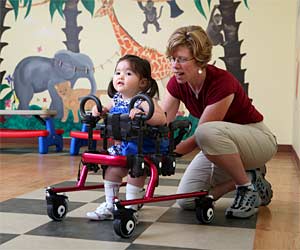
- Supported Gait Training: Early research supports treadmill and overground stepping devices to allow children to practice the movement patterns of walking before they can do so independently. This helps actively build neural pathways for motor independence and drives cognition forward as they explore the world. Supported stepping starts at around 9-12 months (adjusted/corrected age in cases of prematurity).10
- Bimanual training: Trains both hands to work together in functional activities- particularly effective for bilateral CP where both sides of the body are affected.11
- Constraint- Induced Movement Therapy (CIMT): Play-based format where the less affected limb is restricted to encourage active use and development of the more affected one.12
- GAME (Goals Activity Motor Enrichment): Home-based program where therapists coach parents to deliver task-specific therapy in the child’s natural environment.13
Adaptive Positioning for Cerebral Palsy
As your child grows and learns, their goals and your child’s agency will grow with them. The right upright mobility devices make this progress tangible. These adaptive positioning devices offer postural support to help them stay aligned and build opportunities for participation in daily life.
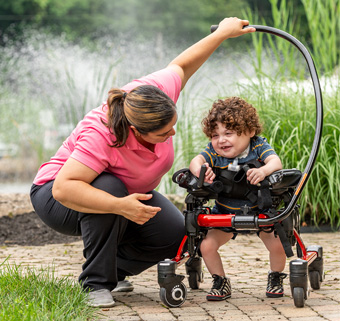
- Adapted standers allow young children to be upright and engaged with their peers and family, building critical foundational skills.
- Supported stepping devices or gait trainers are specifically built for pediatric users and give children the ability to self-initiate exploration and increase mobility.
Adaptive devices designed for pediatric users and used with the guidance of early intervention physical and occupational therapists give children a way to practice skills before they can perform them independently. This practice builds the neural pathways that increased motor independence requires.
These opportunities will give your child something no clinical outcome measure can fully capture: the chance to engage with the world on their own terms.
Your state’s Early Intervention program can support your child with the positioning and mobility technology they need at the right time to help give them the right start for the future.
Parents are the Key to Early Intervention Success
Parents – you are the key to your child’s future! Advocate today for services and technology under Part C of IDEA – it’s the federal law (also known as Early Intervention). Here are four take-home points that will be your keys to early intervention success:
- Talk to your pediatrician about your concerns.
- Contact your state’s EI program. Your EI coordinator will schedule a comprehensive team assessment for your child.
- Work with a multidisciplinary team, remembering you are a key part of the team.
- Participate actively in services.
PT, OT, and speech-language pathology working together will produce better outcomes than any single provider. Physical therapy for children with cerebral palsy is most effective when it connects with the child’s broader goals and the strategies families use between visits.
And beyond this: research consistently shows that parent involvement is one of the strongest predictors of positive outcomes.9 Ask your team to COACH you on techniques and adaptive devices that you can use every day at home.
Remember – intervention happens between visits!
References
- Novak I, Jackman M, Finch-Edmondson M, Fahey M. Cerebral palsy. The Lancet. 2025;406(10499):174-188. doi:10.1016/S0140-6736(25)00686-5.
- Centers for Disease Control and Prevention. Data and statistics for cerebral palsy. CDC Archive. Published December 29, 2020. Accessed August 5, 2026. https://archive.cdc.gov/www_cdc_gov/ncbddd/cp/data.html
- Novak I, Morgan C, Adde L, et al. Early, accurate diagnosis and early intervention in cerebral palsy: advances in diagnosis and treatment. JAMA Pediatr. 2017;171(9):897-907. doi:10.1001/jamapediatrics.2017.1689
- Morgan C, Romeo DM, Chorna O, et al. The pooled diagnostic accuracy of neuroimaging, general movements, and neurological examination for diagnosing cerebral palsy early in high-risk infants: a case control study. J Clin Med. 2019;8(1):8. doi:10.3390/jcm8010008
- Einspieler C, Prechtl HFR, Bos AF, Ferrari F, Cioni G. Prechtl's Method on the Qualitative Assessment of General Movements in Preterm, Term and Young Infants. Mac Keith Press; 2004. https://general-movements-trust.info/53/manual
- Haataja L, Mercuri E, Regev R, et al. Optimality score for the neurologic examination of the infant at 12 and 18 months of age. J Pediatr. 1999;135(2 Pt 1):153-161. doi:10.1016/s0022-3476(99)70016-8
- Damiano DL. The E-words for promoting development and neuroplasticity for infants with or at high risk for cerebral palsy. Dev Med Child Neurol. 2026;68(1):20-28. doi:10.1111/dmcn.16477
- Morgan C, Fetters L, Adde L, et al. Early intervention for children aged 0 to 2 years with or at high risk of cerebral palsy: international clinical practice guideline based on systematic reviews. JAMA Pediatr. 2021;175(8):846-858. doi:10.1001/jamapediatrics.2021.0878
- Novak I, Morgan C, Adde L, et al. Early intervention for children aged 0 to 2 years with or at high risk of cerebral palsy: international clinical practice guideline based on systematic reviews. JAMA Pediatr. 2021;175(8):846-858. doi:10.1001/jamapediatrics.2021.1319
- Paleg G, Livingstone R. Use of overground supported-stepping devices for non-ambulant children, adolescents, and adults with cerebral palsy: a scoping review. Dev Med Child Neurol. 2023;3(2):12. doi:10.3389/fneur.2022.1005485.
- Bleyenheuft Y, Brandão MB, Ziegler AL, et al. Efficacy of hand-arm bimanual intensive therapy including lower extremity (HABIT-ILE) in children with bilateral cerebral palsy: a multi-site randomized controlled trial. Dev Med Child Neurol. 2025;67(4):412-421. doi:10.1111/dmcn.16012
- Eliasson AC, Krumlinde-Sundholm L, Shaw K, Wang C. Effects of constraint-induced movement therapy in young children with hemiplegic cerebral palsy: an exploratory randomized controlled trial. Dev Med Child Neurol. 2005;47(12):811-819. doi:10.1111/j.1469-8749.2005.tb01132.x
- Morgan C, Novak I, Badawi N, et al. Goals - Activity - Motor Enrichment (GAME) early intervention for infants at high risk of cerebral palsy: a single-blind randomized controlled trial. Res Dev Disabil. 2016;55:256-267. doi:10.1016/j.ridd.2016.04.005