7 Tips for Setting and Reaching Feeding Goals
| September 2026Molly Polacco is the ASHA CE Content Consultant for Education Resources Inc (ERI).
ARTICLE SUMMARY
Effective speech therapy goals for pediatric feeding and swallowing begin with a thorough assessment and reflect what matters to the child and family. For SLPs working in feeding therapy, well-designed goals should be individualized, functional, measurable, and flexible enough to evolve with the child’s progress.
- Begin with a comprehensive feeding and swallowing assessment to inform individualized goals.
- Use the SMART framework to make SLP goals specific, measurable, achievable, relevant, and time bound.
- Use a speech therapy goal bank as a starting point—not a substitute for individualized clinical reasoning.
- Prioritize functional goals that support real-world mealtime participation and carryover.
- Track progress, collaborate with caregivers and other providers, and create a safe, supportive environment for learning.
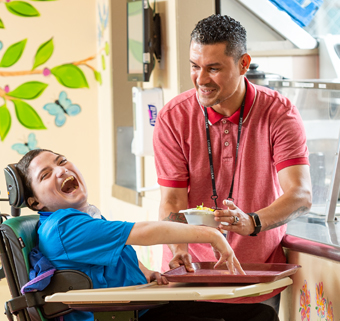 To make meaningful progress in therapy, a clear goal is necessary to drive care. For speech-language pathologists (SLPs), speech therapy goals may address a wide range of needs within their scope of practice, including communication as well as pediatric feeding and swallowing. Particularly in feeding therapy, making and reaching feeding and swallowing goals requires a multi-faceted, family-driven approach to care with buy-in from the entire care team.
The following seven tips provide insight into how to write and reach feeding therapy goals that help children reach their goals in sessions with carryover at home.
#1 – Start With a Comprehensive Feeding and Swallowing Assessment
Before therapy can begin and goals can be determined, the first step is always to complete a thorough, comprehensive evaluation. As with other types of speech therapy assessments, goal development begins with understanding the child’s current abilities, challenges, environment, and functional needs.
When aspiration (food/liquid entering the airway) is of concern, an instrumental swallowing evaluation such as a Fiberoptic Endoscopic Evaluation of Swallowing (FEES) or Videofluoroscopic Swallowing Study (VFSS) is the gold standard to determine the underlying physiology to guide treatment planning with targeted physiology-based exercises.1
Blanket exercises prescribed without a visualization of the swallow can lead to more detrimental outcomes at times than quality care. For example, a child with a long-standing history of reflux and complaints of globus (i.e., food feeling “stuck”) may be prescribed to “swallow hard” and complete effortful swallows before completion of a VFSS. However, after this assessment, a cricopharyngeal bar (prominent thickening of the cricopharyngeal muscle) may be identified that could worsen with this increased swallowing pressure.
In feeding therapy, a thorough evaluation is comprised of informal observations, parent/caregiver report, rapport building with the child, an oral motor evaluation (if the child consents and has trust in the clinician), and a thorough case history.2 To address the multi-faceted nature of pediatric feeding disorders, clinicians can use a standardized parent-report questionnaire such as the Pedi-EAT—a validated tool frequently used to quantify child feeding problems.3
After this thorough assessment, which may take a period of sessions to build rapport and trust, assessment data will then assist the clinician in creating realistic, individualized, child- and family-centered goals. Goals without a thorough assessment can be too vague, unattainable, and lack personalized care.
#2 – Use the SMART Framework to Write SLP Goals
As many clinicians may remember from graduate school, SMART goals help guide clinicians to write clear, measurable goals. In interdisciplinary rehabilitation settings, the SMART framework serves as a practical, standardized method to help clinicians construct specific goals.4
Whether an SLP is developing communication, language, or feeding and swallowing goals, the SMART framework can help turn assessment findings into clear, measurable targets for therapy.
The SMART acronym includes:
- S – Specific
- M – Measurable
- A – Achievable
- R – Relevant
- T – Time Bound
In clinical practice, a feeding-therapy SMART goal after a VFSS may be:
“Aisha will consume thin liquids via straw without known clinical indicators of aspiration (i.e. coughing) 90% of the time across three consecutive sessions by November.”
Without the SMART format, this same goal may sound like, “ill consume thin liquids without signs of aspiration,” leading to a vague time frame, confusion between providers, and lack of time relevance for the patient and family.
When writing goals, each component matters, and the overall goal must be highly meaningful to the patient/family. Goals need to be specific to the child, measurable across time to ensure that progress is occurring and therapy is working, achievable and realistic for the child and family, relevant and culturally sensitive to ensure optimal buy-in from families, and time-bound to further gauge progress.
Consistently writing new goals, especially in a new setting, can be challenging. However, goal banks can be helpful when getting started.
#3 – Build a Speech Therapy Goal Bank for Feeding and Swallowing Goals
A speech therapy goal bank can give SLPs a useful starting point for developing individualized goals across areas of practice. For feeding and swallowing therapy, goal banks may be organized into subsections such as dysphagia, feeding, sensory regulation, and other areas of need.
Goal banks contain curated, pre-written, evidence-based goals that can help offload mental burden during goal writing while providing a framework clinicians can adapt. These goals should be edited and tailored to the specific child to ensure that they reflect individual needs, ability level, diagnosis, and real-world functional goals.
Goal banks can also help ensure that the appropriate language is being used for insurance companies to justify services and ongoing care.
Modern digital applications—such as the GOALed app (available on Google Play Store and Apple App Store)—provide a streamlined platform to write, score, and interpret individualized goals. Physical therapists Cynthia Dodds, with the Medical University of South Carolina, and Lori Bartleson, currently with Charleston Southern University, co-authored an article published in Pediatric Physical Therapy discussing the use of the GOALed App.5 I personally have no experience with this app and therefore do not specifically endorse it; nonetheless, it is interesting to take note of tools available. With the use of any app, data safety and HIPAA compliance are essential.
With these goal banks, remember that they are not to be used as blanket goals for all families. Goals should reflect what matters most to the individual child and their family, not just what’s easy to measure and complete in therapy.
#4 – What Makes a Strong SLP Goal? Prioritize Functional, Real-World Goals
Whether clinicians are developing feeding and swallowing goals, articulation goals, or other language goals for speech therapy, the underlying principle is similar: goals should grow out of assessment findings and the individual’s functional needs.
A strong SLP goal provides a meaningful target for therapy while giving the clinician, child, family, and other members of the care team a clear way to understand and monitor progress.
Motor planning principles remind us that the best way to achieve progress is by completing the actual task at hand.6 For example, the best way to improve mastication (i.e., chewing to break down food) is by chewing real food.7
When writing feeding/swallowing goals, clinicians need to consider the functional impact of these goals and what the ultimate goal is outside of the clinic, rather than what is easy to measure in an isolated therapy session.
This may look like targeted chewing practice with advanced textures in the therapy session guided by a skilled, trained clinician, rather than completing a set number of chews on a non-food item (i.e., teether) to “meet” a measurable therapy session goal. These functional, real-world tasks that are guided and based on motor planning principles will ultimately lead to better carryover and generalization of these skills.
When motor planning is not of concern and rather sensory regulation/integration is, the clinician must try to understand and replicate the sensory demands that occur in the home environment, rather than an isolated therapy room, to optimize carryover and address barriers that may occur.
Above all, when creating these goals, families and caregivers must be included in the conversation. If the goals are not functional and meaningful to them, carryover and buy-in simply won’t occur, ultimately leading to stagnant progress.
#5 – Track Progress and Adjust Goals Regularly
Once a goal is written, remember that it will be fluid. Goals guide treatment; however, clinicians must remember that optimal care requires ongoing conversations with families as well as data collection to determine if a goal must be pivoted, adjusted, advanced, or continued.
Across therapy sessions, track parent/caregiver reports, percentage accuracy over trials (when indicated), behavioral changes/acceptances towards food, decreased clinical indicators/signs of aspiration, etc., to monitor goal progress.
Depending on the practice setting, re-evaluations may be required. At these times, ensure that the previous goals remain valid and functional.
In acute care, children may be discharged before a re-evaluation is completed. In outpatient therapy, a change in medical status, insurance authorization, and/or prolonged time may require a re-assessment.
In school-based practice, consistent progress monitoring is essential to fulfill Individualized Education Program (IEP) data mandates and to justify the educational relevance of the feeding goals. The integrated feeding goals and short-term objectives will safely support a student’s health and participation during mealtime routines.8
Remember – goals must be challenging but achievable; goals that are too easy or too hard indicate that adjustment is needed.
#6 – Involve the Whole Team – Including Caregivers and Medical Providers
The most effective goals with the best carryover and generalization will be goals created in tandem with the caregivers and medical providers.9 Multidisciplinary input ensures that buy-in is achieved from the child’s team, resulting in mutual understanding and reinforcement of the same goals to allow for optimal generalization into the home/community.
When these goals are written, they should be culturally sensitive, and they must optimize health literacy to ensure that everyone on the team can understand them. When everyone on the child’s team is working toward shared, meaningful goals, there is greater opportunity to support progress.
In the school setting, IEPs allow for a formal meeting to discuss these goals; however, on the medical side, these meetings may not occur unless a family meeting is called. As clinicians, informal check-ins with the child’s team matter to ensure these goals remain relevant and appropriate.
#7 – Create the Right Environment for Every Goal
Above all, if a child does not feel safe, learning cannot occur.10 This matters when we are considering the learning environment at home and in therapy.
This includes sensory regulation, optimal positioning, building trust and rapport with the patient and the family, decreasing environmental overstimulation, and decreasing anxiety.
Without the proper learning environment, even the best goals won’t succeed.
Putting Feeding Therapy Goals into Practice
With these seven tips in mind, goal-writing doesn’t have to be daunting. Like other speech therapy goals, feeding goals should begin with a thorough assessment, reflect the individual needs of the child and family, and provide a clear, measurable path toward meaningful progress.
Remember that feeding/swallowing goals must include multidisciplinary buy-in, be fluid over time with consistent re-assessment, and remain functional with real-world application. A goal bank or framework can help clinicians get started, but thoughtful assessment, clinical reasoning, collaboration, and an understanding of what matters to the child and family are what make those goals meaningful.
References
- Yang S, Park JW, Min K, et al. Clinical Practice Guidelines for Oropharyngeal Dysphagia. Ann Rehabil Med. 2023;47(Suppl 1):S1-S26. doi:10.5535/arm.23069
- American Speech-Language-Hearing Association. Pediatric Feeding and Swallowing. American Speech-Language-Hearing Association. Accessed July 17, 2026. https://www.asha.org/practice-portal/clinical-topics/pediatric-feeding-and-swallowing/
- Destriatania S, Februhartanty J, Nurwidya F, Sekartini R. Feeding Problems Assessment Tools in Children: A Scoping Review. Children. 2025; 12(1):37. https://doi.org/10.3390/children12010037
- Bovend'Eerdt TJ, Botell RE, Wade DT. Writing SMART rehabilitation goals and achieving goal attainment scaling: a practical guide. Clin Rehabil. 2009;23(4):352-361. doi:10.1177/0269215508101741
- Gaffney E, Gaffney K, Bartleson L, Dodds C. Goal Attainment Scaling Made Easy With an App: GOALed. Pediatr Phys Ther. 2019;31(2):225-230. doi:10.1097/PEP.0000000000000602
- Zimmerman E, Carnaby G, Lazarus CL, Malandraki GA. Motor Learning, Neuroplasticity, and Strength and Skill Training: Moving From Compensation to Retraining in Behavioral Management of Dysphagia. Am J Speech Lang Pathol. 2020;29(2S):1065-1077. doi:10.1044/2019_AJSLP-19-00088
- Something to chew on: motor learning and neural plasticity principles in oral motor feeding therapy. The Informed SLP. Published February 10, 2023. Accessed July 17, 2026.
- Bruns DA, Thompson SE. Integrating feeding goals into IEPs. Teaching Exceptional Children. 2015;47(4):214-222. https://www.feedingmatters.org/wp-content/uploads/2023/04/Integrating-Feeding-Goals-into-IEPs.pdf
- Nematifard T, Arsalani N, Nourozi Tabrizi K, Fallahi-Khoshknab M, Borimnejad L. Improvement of family-centered care in the pediatric rehabilitation ward: a participatory action research. Front Pediatr. 2024;12:1325235. Published 2024 Jun 21. doi:10.3389/fped.2024.1325235
- Porges SW. Polyvagal Theory: A Science of Safety. Front Integr Neurosci. 2022;16:871227. Published 2022 May 10. doi:10.3389/fnint.2022.871227