
Beyond Support: The Meaningful Impact of the Use of Adaptive Equipment for Activities of Daily Living
| June 2026ARTICLE SUMMARY
Adaptive equipment for activities of daily living (ADLs) can do far more than provide physical support. This blog explores how adaptive ADL equipment, assistive devices, and mobility aids help individuals participate more actively in everyday tasks while improving comfort, safety, and quality of life. Readers will also learn how caregivers benefit from adaptive tools for occupational therapy and task-based routines.
- Adaptive equipment for ADLs can improve participation in feeding, bathing, toileting, and other activities of daily living
- Proper seating and positioning can support trunk control, fine motor skills, and self-care abilities
- Daily living aids and adapted equipment can help promote independent living and greater autonomy
- Mobility aids and standing systems encourage safe participation in upright activities and transfers
- Caregivers can reduce physical strain and improve daily routines with the right assistive devices and support systems
 BACKGROUND
Adaptive equipment is a foundational component of care for individuals with mobility impairments. While perhaps the most obvious reason for its use is to provide upright support for individuals who need it, deeper examination highlights a broader and more meaningful range of benefits. This is especially true in regards to adaptive equipment for activities of daily living (ADLs) such as feeding, bathing and toileting.
When used to foster participation and increased independence, rather than just passive positioning, adaptive equipment can play an integral role in bridging the gap between an individual’s abilities and the demands of everyday activities across a wide range of environments. Research suggests that using a top-down approach, with task-based goal-directed activities, yields greater improvement than bottom-up interventions.1 Additionally, evidence has shown that an assistive device is most effective when integrated into daily routines.2 Aligning with the The ICF and the Developmentally Disabled, the use of adaptive equipment with caregiver facilitated partial-participation in a task-based activity (ie: ADLs) increases activity-based engagement and function.3 Increased meaningful participation with the use of assistive devices and assistive technology, especially in areas such as maintaining body position, self-care, and communication, can improve the individual’s autonomy, dignity, social interactions, and overall sense of well-being.4
Today, many families rely on daily living aids and adaptive tools for occupational therapy to help children participate more fully in everyday tasks. From specialized seating systems to adapted utensils, adaptive ADL equipment can support safer positioning, improved posture, and greater independent living skills at home, school, and in the community.
Interdependence is a concept that describes a dynamic, bidirectional relationship between caregiver and care recipient, even without full independence on the part of the care recipient. Importantly, with the use of adaptive devices, children at higher GMFCS levels can gain more autonomy; adaptive devices can promote reciprocal interactions with caregivers. With appropriate use of adaptive devices specific to ADLs, caregiver and care recipient interdependence can improve.
When it comes to ADLs, adaptive equipment not only supports the individual; it also supports caregivers. Appropriate adaptive equipment and positioning can ease caregiving and provide peace of mind.3,4 In general, a higher GMFCS level correlates with increased assistive device use.5 This suggests that it is important for caregivers to feel confident in their ability to provide safe and efficient assistance when providing ADL care, especially as user needs increase.
Research shows that caregivers are more likely to use adaptive equipment if it eases caregiving.6 In the 2024 study in Norway authored by researchers Moen and Østensjø, families frequently report that assistive devices significantly improve ease of care, underscoring the importance of adaptive equipment in ADLs not only for the individual but for the caregiving system as a whole.6
Adaptive Seating and ADLs
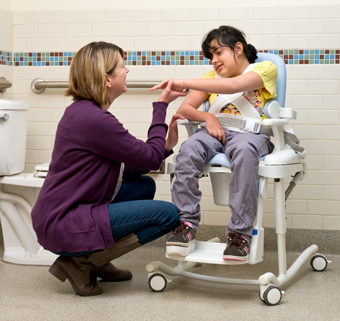
Specialized seating systems, bath chairs, toileting systems, and adaptive chairs provide the stability many individuals need to participate across a wide variety of ADLs. These chairs can be task specific or can be designed to be used for many functions. Many can be easily adjusted to accommodate the level of support that is just right for the individual, taking into consideration variable tone, fatigue level and changes in task. Emerging evidence has shown that introduction of appropriate adaptive seating can improve trunk control and head control with subsequent benefits in fine motor control and self-care.7 Improvements in self-care and fine motor control may occur simply by providing consistent upright positioning for dining, bathing and toileting, via adaptive seating appropriate for the GMFCS level.
Additional upper extremity supports such as arm rests, trays or anchors can be utilized to further promote upright postural control and success in participation across many ADLs but especially during dining when head control is most important.
A key component of adaptive seating is to provide an appropriate amount of postural control to allow for distal mobility and participation in fine motor tasks.7 While modified utensils, toothbrushes or hairbrushes with built-up or angled handles, handheld shower heads or long handled loofahs can support partial independence in some individuals, these ADL tools and adaptive equipment for activities of daily living are only effective when combined with appropriate postural support.
Supported Standing, Mobility Aids, and ADLs
In many cases, supported standing can be a functional position to promote participation in ADLs. When appropriate, postural support can be provided through adaptive equipment to allow for safe access for ADLs in the upright position. Examples include the use of a standing (static or mobile) or gait training device for standing participation in hand or face washing and hair or tooth brushing at the bathroom sink/counter. Participation in standing for diaper/brief change could be performed in a gait training device, standing while holding onto a grab bar, counter top, mat surface, or at a Rifton Support Station. Again, many of these devices are fully adjustable to meet a wide variety of needs and can be adjusted based on the individual’s ability level for a specific task or activity.
Mobility aids such as gait trainers, walkers, and standing systems can also support independent living by allowing individuals to participate more actively in self-care and social routines. Consistent use of adaptive ADL equipment may improve comfort, participation, and long-term engagement in meaningful activities.
Transfers and ADLs
No matter the adaptive equipment being utilized, transfers into and out of the device are a great time to practice weight bearing during the transition of sit-to-stand or with a stand-pivot transfer. The premise of motor learning supports starting this habit at a young age, when neuroplasticity is high, and providing a high number of repetitions/opportunities to perform the motor movement. High-level evidence for the effectiveness of task-specific training in children with cerebral palsy suggests that consistently using these opportunities for transfers during ADLs could lead to improved function over time. 1,8
SUMMARY
When engaging in ADLs, assistive devices can contribute to increased participation and quality of life.3,4 Even when full independence is not achievable, the opportunity for an individual to engage in daily routines to the best of their ability has meaningful, multifaceted benefits. Functional task-based routines embedded into daily life promote progress.1 For caregivers, these tools can help reduce the physical demands of care, lower the risk of injury, and improve efficiency, making daily routines more sustainable over time.3,6,9
As adaptive equipment for ADLs continues to evolve, families and clinicians have more opportunities to tailor supports to each individual’s goals and abilities. The right combination of daily living aids, assistive devices, and adapted equipment can empower individuals to participate more fully in activities of daily living while supporting safety, comfort, and dignity.
References
- Novak I, Morgan C, Fahey M, et al. State of the Evidence Traffic Lights 2019: Systematic Review of Interventions for Preventing and Treating Children with Cerebral Palsy. Curr Neurol Neurosci Rep. 2020;20(2):3. Published 2020 Feb 21. doi:10.1007/s11910-020-1022-z
- Paleg GS, Williams SA, Livingstone RW. Supported Standing and Supported Stepping Devices for Children with Non-Ambulant Cerebral Palsy: An Interdependence and F-Words Focus. Int J Environ Res Public Health. 2024;21(6):669. Published 2024 May 23. doi:10.3390/ijerph21060669
- Jackman M, Sakzewski L, Morgan C, et al. Interventions to improve physical function for children and young people with cerebral palsy: international clinical practice guideline. Dev Med Child Neurol. 2022;64(5):536-549. doi:10.1111/dmcn.15055
- Hoekstra D, Thiele A. The role of assistive devices and technologies in the activities and participation in everyday life of children with cerebral palsy - a scoping review. Disabil Rehabil Assist Technol. 2025;20(7):1994-2015. doi:10.1080/17483107.2025.2549905
- Livingstone RW, Field DA. Wheeled Mobility, Seating, and Bathroom Device Use by Children With Cerebral Palsy. Can J Occup Ther. Published online February 20, 2026. doi:10.1177/00084174261421406
- Moen RD, Østensjø S. Understanding the use and benefits of assistive devices among young children with cerebral palsy and their families in Norway: a cross-sectional population-based registry study. Disabil Rehabil Assist Technol. 2024;19(4):1454-1462. doi:10.1080/17483107.2023.2198563
- Inthachom R, Prasertsukdee S, Ryan SE, Kaewkungwal J, Limpaninlachat S. Evaluation of the multidimensional effects of adaptive seating interventions for young children with non-ambulatory cerebral palsy. Disabil Rehabil Assist Technol. 2021;16(7):780-788. doi:10.1080/17483107.2020.1731613
- Schmidt RA. A schema theory of discrete motor skill learning. Psychol Rev. 1975;82(4):225-260. doi:10.1037/h0076770
- McLeod S, Makino A, Kawamura A. Care for children and youth with cerebral palsy (GMFCS levels III to V). Paediatr Child Health. 2024 May 31;29(3):189-196. doi: 10.1093/pch/pxae003.


