Using Trunk Supports to Improve Trunk Control and Trunk Strength on Rifton Standing Frames
Teaching Caregivers to See the “Big Picture” of Trunk Control
| June 2026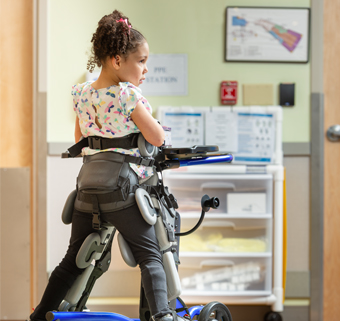 Most infants are born with normally functioning musculoskeletal systems and grow up oblivious to the complex processes required to lift a fork to their mouth, roll over in bed, or stroll through the park. The brain signals muscles to move, and healthy bones and joints function reliably. However, an infant or child with a condition such as prematurity, genetic differences, or brain injury may experience dysfunctional neuromuscular transmission, which eventually can impact this child’s bone and joint development.
When muscles move in unusual patterns (abnormal tone) or don’t move frequently enough, they tend to get tight (develop contractures).1 Since infants’ bones are soft and not fully formed, the presence – or absence – of mechanical tension from muscle contractions can affect how the skeletal system is formed. Growing up with complex medical conditions may result in a greater risk for scoliosis (curvature of the spine), hip dysplasia (unstable hips that become flattened and painful) and decreased bone density (fragile bones).2,3 Often these changes occur so gradually that they can be missed unless caregivers and medical professionals are anticipating and proactively working to prevent them.
Most caregivers understand and recognize when their child doesn’t “look straight,” but they may not be aware that some positions are more important than others to protect their child’s body shape. For example:
-
Hip-healthy positioning is essential
for every infant to safeguard their developing hip sockets. There is evidence of hip dypslasia in nearly 15% of all newborns.4 In these instances, clinicians recommend placing the infant’s legs in an open (abducted) position to better seat the ball of the leg bone (femoral head) deep within the socket of the hip (acetabulum). This helps the joint to become round and stable. A typically growing toddler will naturally start standing and walking in the abducted hip position for more stability. By the same token, children who require support to stand also benefit from adaptive standers that can be positioned in hip abduction to minimize the risk of hip dysplasia.5,6,7 -
Proper spinal alignment begins with a level and stable pelvis.
The pelvis is the foundation (base of support) for the spine and head. If it is not level when a child is sitting or standing, the spinal column will tend to lean toward the lower side of the pelvis, and then compensate back toward the opposite side, in an effort to keep the head more centrally positioned over the body.7,8 Adaptive standers with independent leg and foot supports allow for precise adjustments to accommodate leg length discrepancies or muscle tightness, ensuring the pelvis remains level and correctly aligned. This stable positioning also supports better trunk muscle activation and can help improve trunk control in standing over time. -
Upright and balanced head positioning
is also important for daily life, from eating and socializing to simply observing the world. Imagine the head as a 5-7 lb bowling ball (the average weight for a five-year-old) supported on the end of a spring (the neck). If the head tilts, it creates a pull on the neck and spine. The further it moves off-center, the more gravity takes over, making it hard to return to neutral. Conversely, when the spine is properly aligned and the head sits squarely on top, it becomes significantly easier to maintain an upright head and trunk.9 Proper anterior trunk support and lateral trunk support can help children maintain this alignment while gradually building active trunk strength. -
Upright and more active standing improves bone density
by facilitating full weight bearing through the legs and feet. For optimal comfort and function, the hips, knees, and ankles should be held in straight alignment to mimic a natural posture. While ankle-foot orthoses provide stability from the ground up, adaptive standers ensure the entire lower body remains properly aligned for children who cannot stand independently. Regular use of standers promotes increased bone density, leading to a stronger, healthier skeletal system.10 As children engage their trunk muscles during standing activities, they can also improve balance, posture, and coordination between the arms and legs.
Evaluate Prior to Stander Fitting
Successful, consistent use of adaptive standers relies on a partnership between caregivers, therapists, teachers, and children. Involving caregivers in the initial fitting empowers them to make future adjustments as the child grows, or as their range of motion or alignment evolves. Caregivers can:
- Assist the clinician during their child’s mat evaluation by helping their child remain relaxed and feel secure. This will ensure a more accurate assessment of the child’s limbs and joint range before the stander is adjusted. Take photos of the child’s position while lying down and make note of where support is needed for best alignment. This can help guide the placement of the trunk and hip laterals on the stander. Take photos from the side view and obtain joint angle measurements to ensure comfortable positioning of the child’s legs. Use of a phone app such as Angle Meter 36011, 12 is helpful for premeasuring hip, knee, and ankle joint angles.
- Measure each body segment (heel to knee, knee to hip, pelvis to underarm, shoulder to top of head) to preset the stander dimensions before transfer.
- Make adjustments starting from the base of support and moving upwards. Establish the pelvis first, then the lower extremities and feet, followed by the chest, shoulders, and head. This step-by-step approach can improve trunk alignment and encourage proper activation of the trunk muscles.
- Refer back to the photos taken during the mat evaluation to confirm that the child has achieved their optimal position after setup.
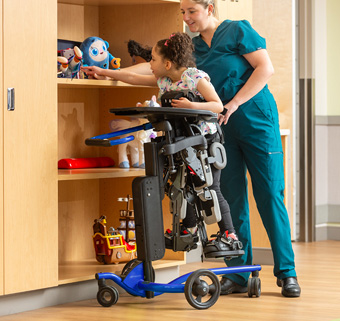
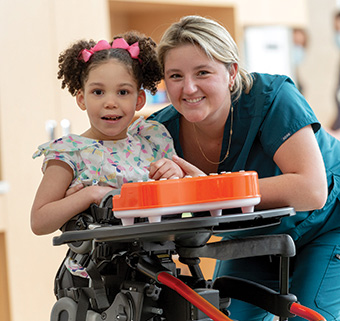
Caregivers can gradually prompt more active trunk and head control through fun activities that require reaching above shoulder level or to the sides. Examples include playing with a balloon suspended on a string at eye level, rolling and corralling a ball on the tray, or reaching for bubbles in different planes. Beyond physical benefits, regular use of a stander often yields improvements in social skills, oral motor control, communication, vision, and hand-eye coordination.13 These activities can also encourage trunk flexion, rotational movement, and stronger postural responses while maintaining a safe sitting position or supported standing posture.
For families wondering how to improve trunk control, consistency is key. Short, engaging standing sessions paired with reaching, turning, and interactive play can gradually improve trunk strength and body awareness. Over time, children may demonstrate better balance, increased endurance, and more confidence during everyday movement activities.
As active control improves, lateral supports at the trunk can be lowered, and chest straps may be loosened or released to allow for greater upper body control and movement. The overall angle of the stander can be adjusted relative to gravity, to increase or reduce challenge as clinically indicated. Adjustments should not compromise alignment and stability and can be done for short periods as tolerated. If the child shows signs of fatigue, they should be repositioned with more support. In time, the head support of a supine stander may be temporarily removed, as the child’s head or upper trunk control improves. Similarly, a child may begin to tolerate prone stander positioning without head support. These gains often transfer to other positions, resulting in better head control during sitting or during tummy time. As support is gradually reduced, children have more opportunities to actively improve trunk control while safely developing independent movement patterns.
References
- Cloodt E, et al. Knee and foot contracture occur earliest in children with cerebral palsy: a longitudinal analysis of 2,693 children. Acta Orthop. 2020;92(2):222-227. doi:10.1080/17453674.2020.1848154
- Hägglund G, et al. Incidence of scoliosis in cerebral palsy. Acta Orthop. 2018;89(4):443-447. doi:10.1080/17453674.2018.1450091
- Krarup LH, et al. Hip displacements and correctable scoliosis were prevalent in children with cerebral palsy registered in a Danish follow-up programme from 2010 to 2020. Acta Paediatr. 2024;113(2):336-343.
- International Hip Dysplasia Institute. International Hip Dysplasia Institute website. Accessed April 7, 2026. https://hipdysplasia.org/
- Presedo A, Rutz E, Howard JJ, Shrader MW, Miller F. The etiology of neuromuscular hip dysplasia and implications for management: a narrative review. Children (Basel). 2024;11(7):844. doi:10.3390/children11070844
- Paleg G, Livingstone R. Evidence-informed clinical perspectives on postural management for hip health in children and adults with non-ambulant cerebral palsy. J Pediatr Rehabil Med. 2022;15(1):39-48. doi:10.3233/PRM-220002
- Hägglund G. Association between pelvic obliquity and scoliosis, hip displacement and asymmetric hip abduction in children with cerebral palsy: a cross-sectional registry study. BMC Musculoskelet Disord. 2020;21(1):464.
- Casey J, et al. Incidence and sequence of scoliosis and windswept hip deformity: which comes first in 4148 children with cerebral palsy? A longitudinal cohort study. BMC Musculoskelet Disord. 2024;25(1):222.
- Saavedra S, et al. Segmental contributions to trunk control in children with moderate-to-severe cerebral palsy. Arch Phys Med Rehabil. 2015;96(6):1088-1097. doi:10.1016/j.apmr.2015.01.016
- Paleg GS, Smith BA, Glickman LB. Systematic review and evidence-based clinical recommendations for dosing of pediatric supported standing programs. Pediatr Phys Ther. 2013;25(3):232-247. doi:10.1097/PEP.0b013e318299d5e7
- Kozlov A. Angle Meter 360. App Store. Accessed April 7, 2026. https://apps.apple.com/us/app/angle-meter-360/id1393860479
- Kozlov AV. Angle Meter 360. Google Play Store. Accessed April 7, 2026. https://play.google.com/store/apps/details?id=com.alekseykozlov.AngleMeter&pli=1
- Paleg GS, Williams SA, Livingstone RW. Supported standing and supported stepping devices for children with non-ambulant cerebral palsy: an interdependence and F-words focus. Int J Environ Res Public Health. 2024;21(6):669. doi:10.3390/ijerph21060669