Adaptive Tricycle
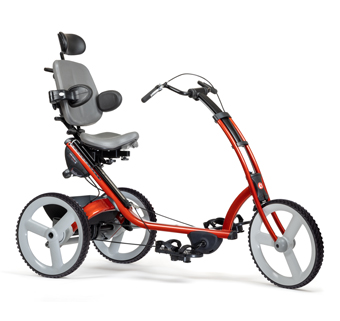
Adapted for kids and teens with physical limitations, these trikes help improve leg strength and reciprocal movement while having fun. What could be better than biking around the block with peers?
At Rifton we’ve always believed that a child with disabilities should have a place of honor among us; they have so much to teach us. Last year we lost a dearly loved member of the extended Rifton family, Kate Wiser, whose short life perfectly demonstrated what we can learn from such a child. Recently we sat down with Kate’s Mom, Roanna, to talk about this. It’s a powerful message that’s worth sharing.
Kate is my youngest child. She has five older sisters and she was born April 28th, 2020.
Of course, a baby in the house is a big deal. My older ones helped take care of her. They were always very involved in her care and the little ones just absolutely adored her. They would hover over her bed and kiss her and take every chance to hold her.
Kate was diagnosed when she was eight months old. We received her diagnosis Christmas Eve, just on the eve of this very joyful Christmas season. And it was, of course, incredibly sobering to our family.
I knew there was something wrong, but I thought she would have some condition, maybe similar to Down syndrome, where she would live for decades and into adulthood and beyond. But here was a diagnosis where she was just given a few years to live with severe disabilities.
It was completely unknown what she could accomplish and what her limits were, how long she would live, what she would be able to do. Would she even interact with us? And she did make progress for two, two and a half, three years. She learned how to sit, she learned how to stand, to bear weight. She learned how to shift her weight and walk and then she eventually got to a point where she could feed herself.
She worked very hard in her therapies. And even when we got to a point where it felt like we weren't progressing anymore, every now and then I would say to the therapist or to the doctors, what really is the point of asking her to work so hard? If we know she's not going to live long, if that's what her diagnosis is, should I be taking her to the pool so she can swim or going horse riding to strengthen her core muscles? Is that the path I should be following? But my feeling always was, and the response I always got from the therapist and the doctors is that it's her quality of life in the moment, right now, whatever you can give her right now so that she can interact, so she can be independent, and don't look too far ahead. Just pour everything you can at that child right now.
The EI professionals were amazing and the way they gave me tools to help my daughter was very helpful.
As a mom, I try to fix problems, I try to set my kids up for long-term success, I try to figure out what they're going to need when they're an adult, and that's how I decide on what I'm going to give them now. But with Kate, the future wasn't there. I mean, I always believed that maybe she would live to adulthood, but it was more about how can I teach her to communicate right now so that when she cries at night and I can't figure out what it is that she needs, she'll be able to communicate with me.
And in the end, Kate, for the last year and a half of her life, lost a lot of the skills that we had worked so hard to gain and that was really, really tough to see. I knew how hard we had worked for those little gains and then to see your child lose and regress, degenerate like that is very challenging.
But that's when Kate taught me that ultimately in a situation like that, or maybe in any situation, the best, the only thing I could do for Kate was sit with her and be with her and sometimes in the moment that had to be enough to just sit on the couch with her and read a story.
Kate had been hospitalized just before Thanksgiving with some common microplasma or something that she should have gotten sick for a day or something, but she ended up in the ER. We came back home with her having recovered more or less and she rallied, she did really well. She came to Thanksgiving dinner. She ate mashed potato and enjoyed herself, interacted with her sisters, sat on the couch, read stories, put up Christmas decorations, a really glowing kind of a weekend. But then by the next Monday, she had gotten sick again.
By the following Saturday, we took her back to the ER and she was pretty much comatose and unresponsive. They tried all kinds of things. They put in all sorts of lines and they finally intubated her. And it was worse than it had ever been, but I didn't realize how bad it was until Monday morning. My husband said, "You know, honey, she might not come home."
Once it was clear, she wasn't going to recover, that she wasn't going to get better, then Conrad and I felt pretty clearly that she had suffered enough. I mean, the last couple of years were really tough on Kate. A lot of seizures, a lot of pain. And what would we be saving her for? So that's when we decided to let her go. We asked the doctors to take the breathing tube out and she went.
I had always feared Kate's death because I wasn't sure how would I respond? Would she suffer more?
We were in the hospital and yet God was there. His presence in that room was amazing and so palpable. And he held all of us individually through that difficult passage. And she went peacefully and I felt like she was freed. Because there was always this tension with Kate. There was this spirit of a little girl, of laughter and dancing and music and loving all the things little kids love. And then there was this body that she was just trapped in and she could not escape from.
When she died, then that was all resolved and that bright sunshine spirit was free. And she won. And I still feel pretty firmly that she's right next to me, dancing along. But not just me, she's also next to all her sisters and so many people.
When Kate was diagnosed, the doctors told us all the things that she would face. She's going to die before she she's ten. She's going to have hard to control seizures. She's going to be wheelchair bound. She'll probably have a G-tube. And they were right about all of it in the end. But what the doctors didn't tell us and what it took me a long time to understand is that was just part of Kate's future. Actually, there was this whole other part of Kate's future, of who Kate was, of Kate's life. There was the laughter, the love, the interaction with her sisters, the playing peekaboo and just giggling when her sister fell off the couch. There were the family memories we have. There was going into the woods with her classmates and them all pulling her along in her wheelchair or helping to push the trike.
So when I sat there on the couch when she was eight months old and heard this diagnosis, I heard all the negative, all the evil, all the hard stuff. By the time she had died and I think what I feel now is that while all that came true, the spirit of God that came through Kate actually overcame all that and found a way to use all of that to bring people together, to touch people, to change my family, to change everyone who knew Kate.
To me, I just wonder that a five and a half year old could touch so many lives. In five and a half years, I learned so many lessons. I wonder what the rest of my life I've been doing. It's just incredible to me. And all of that is God working through a child who you could say, had a very, very difficult life. But I also want to say enjoyed life to the full and was a little sunshine in my house.
I had never been able to accept that that disability was going to be the final word for Kate, that Lissencephaly was going to define Kate. People always said, you have to accept. I could never accept. And I think in the end, I was right because it's not the final word for Kate. Kate is free of all that now.

Request a Free Catalog
Sign up for our newsletter