Increasing Independence with the Rifton Grab Bars and Anchor Family
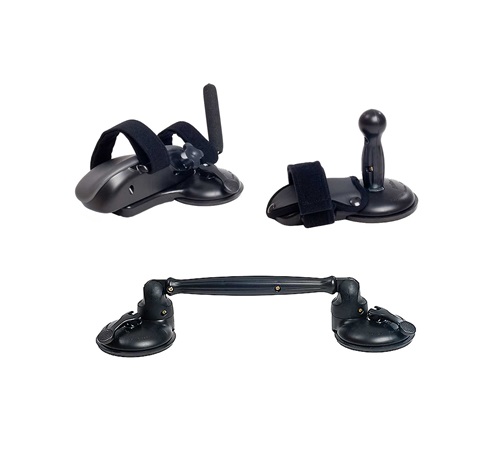
| July 2025 The Rifton Anchors are a family of suction cup grab bars, hand grips, and arm supports. They provide distal arm stabilization to enhance proximal stability of head, shoulder, trunk and pelvis. In essence, they assist students and young adults in becoming more independent in the classroom, community and home. The Rifton Anchors attach to any smooth, horizontal surface such as mealtime or activity trays, and work particularly well with Rifton’s new Adaptive Desk.
Previously, a hierarchical development theory emphasized working on proximal head, shoulder, and pelvic control first. Now we know that providing stabilization of the upper and lower extremities helps to improve the functioning of the core muscles as well. The Rifton Anchors provide this distal stability and can be necessary pieces of adaptive equipment for students in the classroom.
Case Examples with the Rifton Anchors
 Gavin, a student with spastic cerebral palsy in a regular classroom, could suddenly have a bodily spasm and his arms would flail in all directions. Aside from disrupting the class, he would feel embarrassed by the uncontrolled movements of his limbs. We gave him the hand anchor to use on his wheelchair tray. He was able to hold the anchor during his spasms and in this way calm his body’s reactions. He no longer needed assistance to refocus himself after an incident and he was able to be an active participant in the classroom.
Students or young adults with hemiplegia may hold their affected limb in a “high guard” position as they move and reach out with the other limb. This position hampers the development of more dynamic shoulder and trunk movements. Anchoring the affected side provides the stability needed to facilitate normal movement and prevents the body from drifting into asymmetrical compensatory patterns.
Take for example Heather, a young adult with spastic hemiplegia. Heather uses the arm anchor for mealtimes. The arm anchor stabilizes the affected hand in a natural position on the cafeteria table. This in turn keeps her trunk and head in better alignment. She no longer needs to concentrate on sitting while eating and no longer needs an aide to reposition her during the meal. Instead she socializes with her peers.
 As parents, caregivers and therapists our goal is to improve functional ability in the lives of individuals with disabilities. The Rifton Anchors, small and insignificant as they may appear, can make a big difference in improving functional performance in the classroom, community and home.