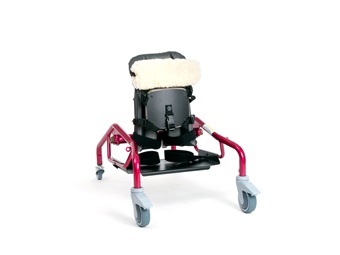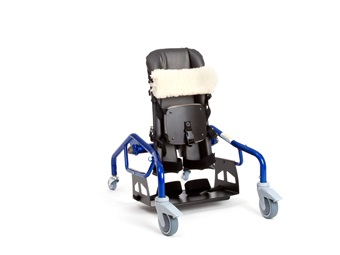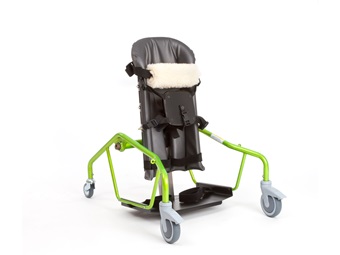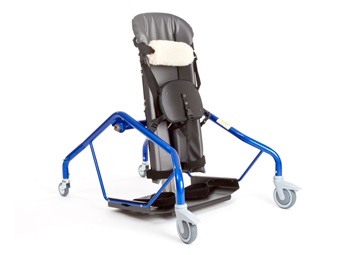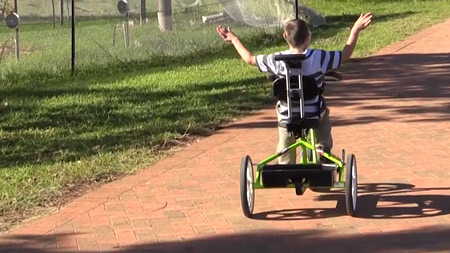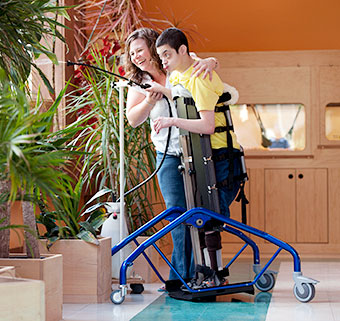
The sit-stand-sit exercise builds body strength and teaches standing.

Where can I learn more about building standing skills?

The MOVE program, Mobility Opportunities Via Education, is an excellent resource for strategies to improve sitting, standing, and walking skills for adulthood.

How does the Dynamic Stander enhance a child’s mobility?

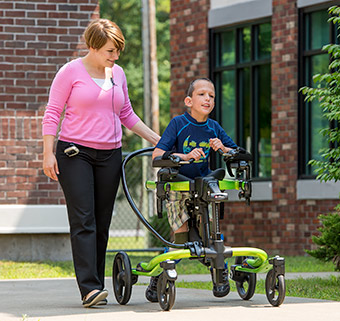
With the large wheels in place, hand rims on the wheels allow many children to easily self-propel the Dynamic Stander. In fact, children unable to propel their own wheelchairs can often discover independent movement when upright. Gym teachers love how the Dynamic Stander allows children to participate in many games and sports. Low-level amputees, children with spina bifida, or children recovering from hip surgery can be upright to move freely among their peers.

The activity of self-propulsion encourages weight shifting, upper trunk and upper extremity strength, range of motion, and balance and righting responses. Independent mobility can improve spatial awareness and may even stimulate language gains. The big casters and large wheels can accommodate level outdoor surfaces for outdoor play. The locks on the large wheel can be reached and operated by children with good hand use or by the caregiver, and transparent plastic guards over the wheel spokes keep little fingers safe.

FAQs about building skills with the Dynamic Stander

With regular use, the Dynamic Stander provides a way for children to build the weight-bearing and postural control needed for standing.

Why is standing so important?

The physical and emotional benefits of standing are proven and extensive. They include improved bone density, prolonged stretch for tight muscles at hips, knees, and ankles, and improved function of the pulmonary and digestive systems.

Standing also provides immeasurable social benefits by enabling a child to interact at the same level as his peers. With opportunity and practice, the child’s ability to participate in the activities of daily living expands – promoting self esteem and cognitive growth. It is truly exciting to see the increasing functional ability of a child who has been regularly using a Dynamic Stander!

How does the Dynamic Stander make activities more accessible?

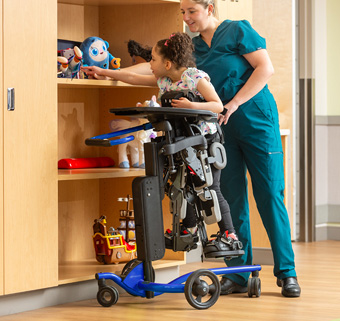
When the large wheels of the Dynamic Stander are removed, the child can roll right up to places and activities in the classroom that may be inaccessible from a wheelchair or other types of standers. Easels, sinks, tables, computers and water fountains are now within comfortable reach. Busy with these engaging tasks, children don't even realize they are working on weight shifting, balance, and postural control!

In addition, a communication tray can attach to the front of the Dynamic Stander as a surface for lightweight table activities.

How does the Dynamic Stander help a child progress toward standing?

With daily standing practice, the Dynamic Stander helps dependent children improve head and trunk control and weight-bearing ability.
Prompts can be gradually removed as a child progresses toward more independent standing, for example:

  • A child who initially required our optional arm prompts to maintain an upright position may gain sufficient strength to maintain head and upper body control with only the body support, seat pad and the soft fleece strap.
  • The angle of our unique adjustable seat pad can be gradually adjusted to promote increased weight bearing through the lower extremities. It is placed more vertically against the pelvis and lower back as the child bears more weight on his own.
  • Eventually, the soft fleece strap may no longer be needed against the child’s upper back. The body support can be lowered from nipple level down close to waist level as the child establishes upper trunk stability.
  • With our Stander, a child can be placed in the reverse position to help develop even greater front-back weight shifting and postural control. The seat pads can be utilized for support at the knees and trunk, and the body support can be positioned as high as needed. In this position, the child has even easier access to activities around him.

In time, the child may be able to bear his own weight without the stander. With some hands-on support for balance, or by leaning against a table or wall, the child may learn to stand on her own. By this time, many children are able to participate in walking activities as well, using a Rifton Pacer or similar gait-training device.

Rifton Equipment | phone: 800-571-8198 | fax: 800-865-4674 | www.rifton.com